When Sketchbooks Became Working Tools
When sketchbooks became working tools, their pages became more than polished displays: learn to read observation, study and revision in the marks.
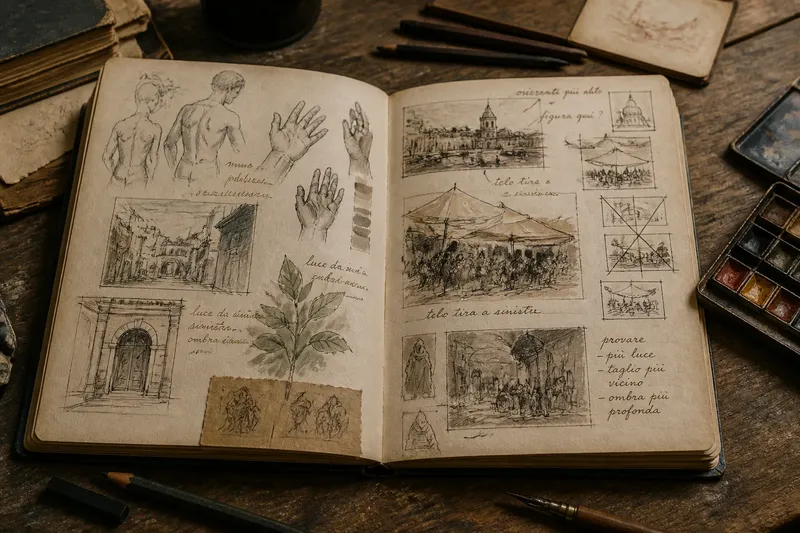
The common mistake is to treat a sketchbook as a gallery of polished drawings. That expectation hides the quick studies, copied motifs and working notes that reveal how artists used books to learn and prepare other work. When sketchbooks became working tools, their pages offered more than finished-looking images: they could support observation, training, design and revision.
This change had no single starting point. In Renaissance workshops, artists and apprentices used drawing to study figures, poses and compositions; later, artists carried books on journeys and made studies outdoors. The purposes overlapped rather than replacing one another. Six roles make that gradual shift easier to see, especially when you connect a page’s marks to the kind of work it helped an artist do.
Sketchbooks for looking
A small drawing of a doorway, plant or face can record a particular encounter: the tilt of a branch, the fold of a sleeve or the spacing between buildings. A page holds a visual reminder that memory alone might blur. In travel and outdoor study, a portable book made it possible to note a view away from the studio.
Artists also used drawing to study what they saw repeatedly. In Renaissance workshops, apprentices copied drawings and studied figures as part of learning how to represent the body and organise a composition. A page of repeated hands or poses can therefore be read not only as a record of interest but as practice in a visual language.
When looking at a historical sketchbook, notice what receives attention. Repeated studies of hands may suggest an effort to understand gesture; several views of one building may show interest in its structure. Subjects are clues, as are omissions, shorthand notes and changes in line.
Sketchbooks for memory
Observation and later work often meet on the page. A sketchbook can carry details from one place or moment into a painting, print, sculpture or design made elsewhere. This role is especially clear in travel and outdoor studies: the artist records a view or motif, then uses that material later in a different setting.
A drawing need not be a blueprint for the final work. Notes about colour, light or placement may matter more than a faithful outline. A quick notation can preserve a relationship—one form crossing another, or a bright patch beside a dark one—while leaving room to change the composition.
Say an artist sees market umbrellas closing in the wind. They sketch the angled canopies, jot “cloth pulling left” and mark where the fabric gathers. Later, the artist uses those notes to shape a larger scene, changing the people and setting. The expected visible result is a composition that retains the remembered pattern of the fabric without copying the original view.
Sketchbooks for study
In workshop training, drawing books could serve as places to copy, practise and keep visual material for future use. A sequence of figure studies might help an apprentice compare poses; repeated attempts at a hand could build familiarity with its structure. The point was not necessarily to preserve a personal diary. A page could function as a lesson or a store of forms.
This helps explain one historical shift: drawing was not only preparation for an individual finished artwork. It could also be part of learning the skills and conventions that made later work possible. The same book might contain copied motifs alongside an artist’s own observations, so page order and repeated subjects matter.
Sketchbooks for trials
A sketchbook gives an artist room to compare possibilities before committing to a finished object. A page might set out several poses, arrange shapes into a rough design or test a line beside a wash of colour. The value lies in seeing alternatives together.
Materials shape these trials. Pencil can be erased or layered; charcoal leaves a soft, changeable mark; ink calls for more decisive lines. Watercolour can show how a transparent wash behaves beside a dry one, while pasted paper or tracing paper can help compare shapes. Such pages record practical questions: Will this form read clearly? Does the arrangement feel balanced? Which mark carries the idea?
A sketchbook is rather like a kitchen table: it can hold separate ingredients while a maker decides what belongs together. A working page may be crowded and provisional because it serves an immediate purpose. Neatness is not the same as progress.
Sketchbooks for revision
Some pages preserve the moment an idea changes direction. An artist may draw one arrangement, cross it out, then place the main form elsewhere. A margin can collect alternatives; a later page may revisit a subject at a different scale or from another viewpoint. These marks record decisions, not simply failed attempts.
Look at the relationship between lines. Does a darker mark reinforce an earlier outline, or replace it? Are notes placed beside a drawing, as if the artist needed to remember an adjustment? Is the page divided into small studies for comparison, or does one image receive repeated changes?
These details can connect separate pictures into a working sequence. The sequence need not move neatly forward: an artist might return to an old page, borrow an earlier study or leave an idea unfinished until another project gives it purpose.
Sketchbooks for unfinished work
An unfinished drawing is not automatically an incomplete document. A fragment may have done its job as soon as it helped the artist remember a pose, test a contour or settle a layout. In other cases, it may preserve a question that the artist did not resolve.
It is tempting to treat every loose drawing as a direct preview of a finished artwork. That can turn reading into a search for familiar images. Instead, ask what each page appears to solve. A hand study may concern gesture rather than a particular figure; small rectangles may test composition rather than map a specific scene.
Some books were private working records; others were shared, shown or collected. Their condition and arrangement affect what survives and how it can be read. A carefully ordered sequence may support comparison, while a mixed volume may combine studies, notes and practical material. The book’s form offers context, but does not reveal the artist’s full intention by itself.
Sketchbook roles today?
Did artists always use sketchbooks in the same way?
No. Workshop study, travel observation, design and personal record are overlapping uses, not stages that every artist followed. The materials, training and purpose of a particular book shape how its pages should be read.
What can repeated drawings tell you?
Repeated figures, objects or poses may point to practice, comparison or a subject the artist needed to understand. Look for nearby notes and changes in line before deciding which interpretation fits best.
How can you tell a study from a plan?
A study often concentrates on a form or detail, while a plan may arrange several elements for a larger work. The distinction is not always clear, so treat page layout, annotations and related studies as clues rather than proof.
Do modern sketchbooks serve different purposes?
Artists may use bound books, loose sheets, digital tablets or a mixture of formats. The tools have changed, but pages can still support observation, experimentation and revision.
Reading the working page
When sketchbooks became working tools, they did not stop being places for drawing. Their history is clearer when you ask what changed from page to page: observation could become training, a remembered motif could inform a design, and a trial could lead to revision. Start with the marks that seem least finished; they may show most plainly what the artist needed the book to do.